Hyderabadi Chicken Biryani
Back to Kitchen Hyderabadi · Main Course · Non-Vegetarian

Chicken Biryani

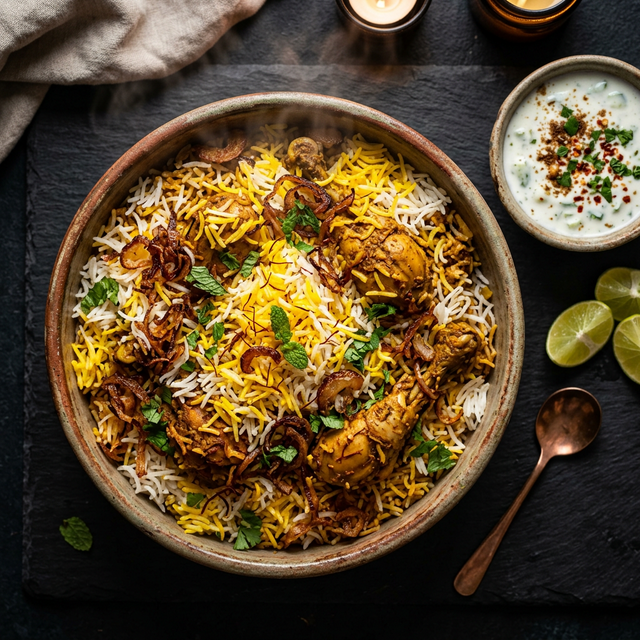
"The crown jewel of Indian cuisine — layers of fragrant basmati rice and spiced chicken, sealed and slow-cooked to perfection"
30 min Prep Time
60 min Cook Time
4-6 Servings
Advanced Difficulty
Heat Level
01 · INGREDIENTS

Your Ingredients

Every ingredient has a role. Here's what each one does chemically — and why it matters.

🍚
Basmati Rice
Chawal
2 cups (aged, long-grain)
Aged basmati has higher amylose content (25-30%), which keeps grains separate. Soaking for 30 min allows starch granules to absorb water, reducing cooking time and preventing breakage.
🍗
Chicken
Murgh
750g (bone-in, cut into pieces)
Bone-in chicken releases collagen during slow cooking, which converts to gelatin at 160°F (71°C). This creates the silky, unctuous mouthfeel that defines great biryani.
🥛
Yogurt
Dahi
1 cup (full-fat, whisked smooth)
Lactic acid denatures surface proteins on the chicken, making it tender. The slightly acidic environment also speeds up the Maillard reaction, deepening color and flavor during cooking.
🧅
Onions
Pyaz
3 large (thinly sliced for frying)
Sliced thin for maximum surface area. At 280°F+, natural sugars and amino acids undergo Maillard reaction, creating 600+ aromatics. "Birista" (crispy fried onions) = concentrated flavor bombs.
🌸
Saffron
Kesar
15-20 strands (soaked in warm milk)
Crocin creates the golden color (water & fat soluble). Safranal provides the floral aroma. Picrocrocin gives the subtle bitterness. Warm milk extracts all three simultaneously — never add saffron to boiling liquid.
🧈
Ghee
Desi Ghee
4 tbsp (clarified butter)
Ghee's high smoke point (vs butter at 350°F) makes it ideal for frying. The removed milk solids mean no burning. Fat-soluble spice compounds (curcumin, capsaicin) dissolve in ghee, spreading flavor evenly.
💚
Green Cardamom
Elaichi
4-5 pods (lightly crushed)
The primary volatile compound is 1,8-cineole, which provides the cool, menthol-like aroma. Crush pods to release — whole pods trap these volatiles inside. Add early to let them infuse into the fat.
🫙
Whole Spices
Garam Masala
Bay leaves, cinnamon, cloves, star anise, mace
Each whole spice releases different volatile compounds at different temperatures. Add to hot oil FIRST — fat-soluble aromatics extract in 30-60 seconds. This "blooming" step is irreplaceable.
🧄
Ginger-Garlic Paste
Adrak-Lehsun
2 tbsp each (freshly ground)
Allicin (garlic) and gingerol (ginger) are both activated when cells are crushed. Cook for 1-2 min until raw smell disappears — overcooking converts allicin to milder compounds, losing pungency.
02 · THE JOURNEY

Follow the Journey

Each step is timed, each ingredient enters at the exact right moment. Follow along — your biryani will be perfect.

01
Preparation 30 min before cooking

Soak the Basmati Rice

Rinse 2 cups of aged basmati rice under cold running water until the water runs clear (3-4 washes). This removes surface starch. Then soak in clean water for 30 minutes.

🍚 Basmati Rice 💧 Cold Water
Why This Matters
Rinsing removes free amylopectin (sticky starch) from the surface. Soaking allows water to penetrate the starch granules, so grains cook evenly from outside-in and elongate to 1.5x their length instead of breaking.
02
Preparation Minimum 30 min (ideally 2 hours)

Marinate the Chicken

Combine chicken with yogurt, ginger-garlic paste, red chili powder, turmeric, biryani masala, salt, and a squeeze of lemon juice. Mix well, ensuring every piece is coated. Cover and refrigerate.

🍗 Chicken 🥛 Yogurt 🧄 Ginger-Garlic Paste 🌶️ Red Chili Powder 💛 Turmeric 🍋 Lemon
The Chemistry of Marination
Yogurt's lactic acid (pH ~4.5) denatures surface proteins, creating tiny pockets that trap moisture during cooking. Lemon's citric acid boosts this effect. The result? Chicken stays juicy even after 45 min of dum cooking. Do NOT marinate longer than 8 hours — acids will break down proteins too much, making meat mushy.
03
Active Cooking 15-20 min

Fry the Birista (Crispy Onions)

Heat ghee in a heavy-bottomed pot until shimmering. Add thinly sliced onions and fry on medium-high heat, stirring frequently. Watch for the color change: translucent → golden → deep copper brown. Remove 1/3 for garnishing, keep the rest in the pot.

🧈 Ghee 🧅 Onions (3 large)
Medium-High · 350°F (175°C)
Maillard Reaction in Action
At 280°F+, amino acids (proteins) react with reducing sugars in onions to create melanoidins — brown-colored polymers responsible for 600+ unique aromatic compounds. This is THE foundation of biryani's flavor. Thin slices = more surface area = more Maillard reaction = more flavor.
👨‍🍳
Chef's Secret
Add a pinch of salt to the onions early — NaCl draws out moisture via osmosis, which makes onions cook faster and caramelize more evenly. Remove them when they're slightly lighter than your target color — they'll continue browning from residual heat.
04
Active Cooking 1-2 min

Bloom the Whole Spices

In the same ghee (with the remaining fried onions), add bay leaves, cinnamon stick, green cardamom, cloves, star anise, and black peppercorns. Stir for 30-60 seconds until fragrant — you'll hear them crackle and pop.

🍃 Bay Leaves 💚 Cardamom 🟤 Cinnamon ⚫ Cloves ⭐ Star Anise ⚫ Peppercorns
Medium · 320°F (160°C)
Spice Blooming — Volatile Release
Fat-soluble compounds (eugenol from cloves, cinnamaldehyde from cinnamon, anethole from star anise) dissolve into the ghee within 30 seconds. This "blooming" technique extracts up to 10x more flavor than adding spices to water. The crackling sound = moisture escaping as the spice cells rupture, releasing their essential oils.
05
Active Cooking 10-12 min

Sear the Marinated Chicken

Add the marinated chicken pieces (with all the yogurt marinade) to the pot. Increase heat to high and cook for 5 minutes without stirring — let the bottom develop a golden crust. Then flip and cook another 5-7 minutes until the yogurt thickens and the chicken is 70% cooked.

🍗 Marinated Chicken 🫙 All the marinade
High → Medium · 400°F → 350°F
Why Only 70% Cooked?
The chicken will finish cooking during the dum (steaming) phase. If you cook it 100% now, the proteins will over-contract, squeezing out all juices. At 70%, myosin proteins have set but actin proteins are still relaxed — the perfect state for the gentle dum finish.
06
Simultaneous 6-8 min

Parboil the Rice (70% Done)

Bring a large pot of water (8 cups) to a rapid boil. Add whole spices (2 cardamom, 1 bay leaf, 1 cinnamon), salt, and 1 tsp oil. Drain the soaked rice and add it. Boil for exactly 6-8 minutes — the rice should be 70% cooked (firm bite in the center). Drain immediately.

🍚 Soaked Rice 🧂 Salt 💚 Whole Spices 💧 Water (8 cups)
Rolling Boil · 212°F (100°C)
Gelatinization Control
At 70% done, starch granules have absorbed water and begun to swell (gelatinize) but haven't fully burst. During dum, steam will complete the final 30% of cooking. If fully cooked now, the steam would over-gelatinize the starch, creating mushy, sticky rice. The oil in boiling water coats grains, preventing adhesion.
👨‍🍳
The Bite Test
Take one grain and press it between your fingers. It should break cleanly but still have a tiny white core. If there's no white core, you've gone too far. If it doesn't break at all, keep boiling 1 more minute.
07
Assembly 5 min

Layer Rice Over Chicken

Gently spread the parboiled rice over the chicken in an even layer. Create this sequence from bottom to top:
Layer 1: Chicken with gravy (already in the pot)
Layer 2: Rice
Layer 3: Saffron milk (drizzled over)
Layer 4: Birista (crispy onions)
Layer 5: Fresh mint, coriander, and a drizzle of ghee

🍚 Parboiled Rice 🌸 Saffron Milk 🧅 Birista 🌿 Mint & Coriander 🧈 Ghee (drizzle)
Architecture of Layers
The layered structure creates a micro-climate. Bottom chicken layer generates steam and releases fat. Rice layer traps this steam. Saffron milk creates golden streaks as crocin migrates downward via gravity and steam. Mint's menthol and coriander's linalool rise upward as volatiles, infusing the rice from both directions. This two-way flavor transfer is unique to dum cooking.
08
Dum Cooking 25-30 min

Seal & Dum Cook

Place a tight-fitting lid on the pot. Seal the edges with dough (flour + water paste) or wrap a kitchen towel around the lid to trap ALL steam. Cook on the LOWEST heat possible for 25 minutes. Place a heavy tawa (flat pan) under the pot if your stove burner is too strong. Do NOT open the lid during this time.

Lowest Possible Heat · ~200°F (93°C) internal
The Physics of Dum Cooking
Dum = "to breathe" in Urdu. The sealed pot creates a pressurized steam environment. Water vapor rises from the bottom (chicken) layer, hits the lid, condenses, and rains back down — creating a continuous self-basting cycle. Internal temp stays at ~200°F — hot enough to cook but gentle enough to prevent the Maillard reaction on the bottom (no burning). The collagen in chicken bones slowly converts to gelatin, enriching every grain.
👨‍🍳
The Aroma Test
After 20 minutes, you'll start smelling the biryani through the seal — saffron followed by mint. When you smell charred wood (from the bay leaf), it's done. Trust your nose, not the clock.
09
Finish 10 min rest

Rest, Fluff & Serve

Turn off the heat. Let the biryani rest undisturbed for 10 minutes. Then break the seal, gently fluff the rice with a fork (scoop from the sides to preserve layers). Serve on a large platter, garnish with the reserved birista, fresh mint, and a squeeze of lemon. Pair with raita and salan.

🧅 Reserved Birista 🌿 Fresh Mint 🍋 Lemon Wedges 🥛 Raita (side)
Why Rest?
During rest, the temperature equalizes. Starch undergoes retrogradation — amylose chains realign awkwardly, firming up the grains. Muscle fibers in chicken relax, redistributing moisture from the exterior back into the center. If you open immediately, steam escapes and you lose this equilibrium. 10 minutes makes the difference between good and extraordinary biryani.