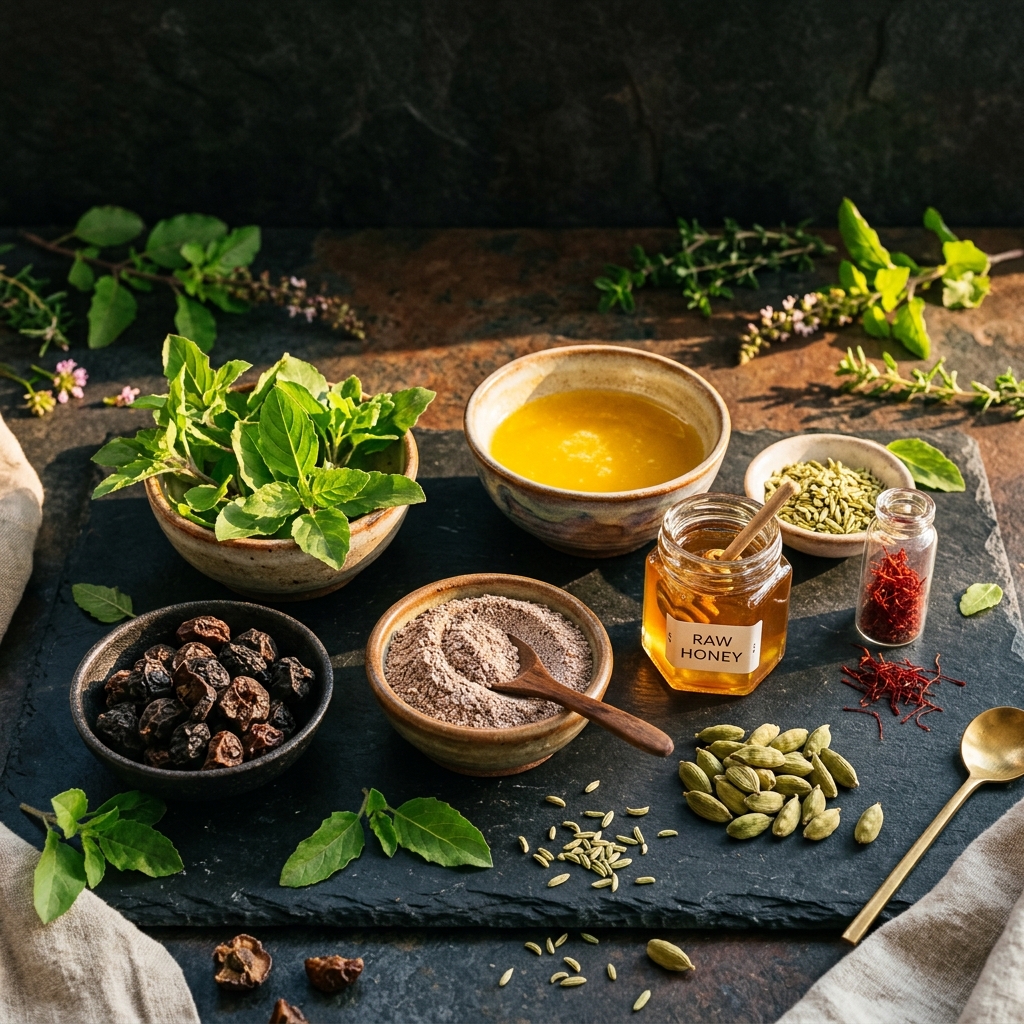
Ancient Wisdom · Modern Nourishment
5,000 years of Ayurvedic wisdom — distilled into simple, nourishing recipes that gently introduce India's sacred flavors to your child's growing palate.
In Ayurveda, a child's first years are the Ksheerannada phase — the sacred transition from milk-only nourishment to the full richness of family food. Ancient texts like the Charaka Samhita and Kashyapa Samhita dedicate entire chapters (Kaumarabhritya) to pediatric nutrition, prescribing foods that build Ojas (vital immunity), strengthen Agni (digestive fire), and nourish Medha (intellect).
Flavor Progression · Stage by Stage
Ayurveda and modern pediatric science agree: spice introduction must be gradual, intentional, and respectful of each child's developmental stage.
The gut is still developing. Focus on mild, digestive-supportive aromatics only. No salt in excess, no chili, no raw spices. Everything must be bloomed in a small amount of ghee to activate and mellow the volatile compounds.
Moong dal khichdi is the perfect first "family meal." Soft mashed rice with ghee, ragi porridge with jaggery, curd rice (Daddojanam), and steamed idli are the building blocks of a strong digestive foundation at this stage.
Prescribed by Kashyapa Samhita: gold ash (Swarna Bhasma) mixed with Brahmi, Vacha, honey and ghee. Traditionally administered on Pushya Nakshatra to enhance intellect, immunity (Bala), and longevity. Only under qualified Ayurvedic guidance.
By 18 months, the digestive system is stronger. Introduce warming spices that are anti-inflammatory and immunity-building. Fresh ginger (grated, never raw piece) can be added to dals and soups.
Introduce dosas, uttapam, and mild sambar (with pumpkin, carrot). The natural fermentation of idli/dosa batter produces beneficial lactic acid bacteria — essentially probiotic food. A cornerstone of the Telugu and Karnataka traditional diet.
Soaked, peeled almonds ground with warm milk — a practice dating back to Charaka's Medhya Rasayana (brain tonics). The soaking process activates alpha-linolenic acid and neutralizes enzyme inhibitors in the skin. Cardamom enhances bioavailability.
Most children can join family meals now — simply set aside their portion before adding chili powder or heavy garam masala to the pot. Mild tadka with black pepper (1–2 whole corns only), fenugreek, and curry leaves is now appropriate.
Karnataka's legendary superfood. Ragi (finger millet) has the highest calcium content of any grain — essential for bone density at ages 2–3 when skeletal growth peaks. It's also rich in iron, fiber, and amino acids.
Haldi doodh (turmeric milk) can now have a tiny pinch of black pepper — piperine increases curcumin bioavailability by 2,000%. Amla (Indian gooseberry) is the world's richest natural source of Vitamin C; introduce as chutney, candy, or murabba.
By age 3–5, children can enjoy most family dishes with moderate spice levels. This is the time to introduce the full "thali" experience — dal, sabzi, rice, roti, curd, and pickle — teaching them the principle of the six tastes (Shad Rasa) that Ayurveda prescribes.
Age 3+ is when traditional Indian families introduce Chyawanprash — an ancient Amla-based herbal jam mentioned in the Charaka Samhita as a Rasayana (rejuvenator). Contains 36+ herbs. A half-teaspoon in warm milk each morning builds baseline immunity.
Ayurveda's nutrition framework: Sweet (rice, milk) · Sour (curd, amla) · Salty (rock salt) · Pungent (ginger, pepper) · Bitter (methi, karela) · Astringent (dal, turmeric). A complete thali covers all six.
Little Rasas · Children's Recipes
Rooted in ancient texts, refined by generations of Indian mothers. Click any recipe to expand the full method.
Exploring ancient recipes for your little one. Rasa Pro unlocks the complete Little Rasas library — all ages, all milestones.
Explore Proపెసర పప్పు ఖిచడి
The gold standard first family meal. Soft-cooked split yellow moong with rice, kissed with ghee, cumin, turmeric and hing. Tridoshic — balances all body types.
రాగి జావ
Karnataka's ancient superfood. Finger millet has 344mg calcium per 100g — more than milk per weight. Essential for bone growth in the first 2 years of skeletal development.
బాదాం పాలు
Charaka's Medhya Rasayana — the original "brain tonic." Soaking and peeling almonds transforms them: the skin inhibits enzyme secretion, while the peeled nut releases alpha-linolenic acid (Omega-3) and Vitamin E.
పసుపు పాలు
India's 3,000-year-old bedtime immunity ritual. Curcumin in turmeric + piperine in black pepper = a molecularly matched pair. Piperine inhibits glucuronidation pathway, extending curcumin's presence in the bloodstream by 2000%.
వేణు పొంగల్
Andhra and Tamil Nadu's sacred breakfast — soft creamy rice and moong dal with cumin, fresh ginger, and a generous pour of ghee. Temple food, hospital food, first food — it crosses all boundaries.
దద్దోజనం
The most beloved comfort food in Andhra and Karnataka. Warm rice mashed with cool yogurt, seasoned with a mustard-curry leaf tadka. Packed with Lactobacillus cultures and essential for gut microbiome health in growing children.
పంచామృతం
Five nectars (Pancha = five, Amrit = nectar). A sacred Ayurvedic tonic of milk, curd, ghee, honey, and raw cane sugar. Each ingredient is a complete food that together covers all six nutritional pathways — protein, fat, probiotic, enzyme, and mineral.
రాగి లడ్డు
Karnataka's legendary energy ball. Roasted ragi flour, jaggery, ghee, and coconut. No baking, no refined sugar. A traditional after-school snack that provides long-lasting energy via complex millet carbohydrates and iron.
పెసర అట్టు
India's ancient protein pancake. Soaked moong dal blended with grated vegetables and gentle spices. Naturally gluten-free, high in plant protein, and crispy enough to be fun for toddlers. The original "fun food" approved by Ayurveda.
సాబూదానా ఖిచడి
Pearl tapioca soaked and stir-fried with peanuts, curry leaves, and cumin. A gentle, gluten-free, easily digestible energy snack perfect for fussy toddlers. The texture naturally engages babies learning to self-feed.
ఉసిరి మురబ్బా
Ancient Indian gooseberry preserve. One small amla = 600mg Vitamin C — 20 times more than an orange. Preserved in sugar or jaggery syrup, making this potent medicine taste like a sweet. A daily tradition in many Telugu households.
చిలగడదుంప పాయసం
Roasted sweet potato + fresh coconut milk + jaggery + cardamom. One of the most nutrient-dense first foods. A single sweet potato provides 400% of a child's daily Vitamin A (as beta-carotene) — essential for vision and immune function.
రాగి అరటి దోసలు
Toddlers go crazy for these. Naturally sweet from ripe banana, crispy on the outside, cloud-soft inside. Zero added sugar. The ragi delivers 344mg calcium per 100g — more than milk. Perfect for little hands learning to self-feed.
పనీర్ కూరగాయల వేళ్ళు
Soft, golden paneer sticks with tiny carrots and peas hidden inside. Kids devour these — the slightly crispy outside and melt-in-mouth inside is irresistible. Loaded with protein (18g per 100g paneer) and calcium for those growing bones.
శెనగ పిండి చీల
Mini chickpea-flour crepes cut into tiny squares — like Indian protein crackers. The ajwain and cumin make the kitchen smell incredible while you cook. Kids grab these off the plate faster than you can cut them. 22g protein per 100g of besan.
నేతి చిలగడ దుంప నాణేలు
Caramelized, golden coins that are naturally the sweetest thing on the plate. One of the highest Vitamin A foods on earth (14,187 IU per 100g). The ghee + cumin glaze makes these addictive — toddlers will sign for more before you sit down.
మినీ ఇడ్లీ వేళ్ళు
South India's ultimate baby food — steamed, fermented, probiotic-rich, and the perfect texture for gummy chewing. Cut into strips for easy gripping. The warm ghee dip with cumin is where the magic happens — toddlers learn to dip and it makes mealtime a game.
కూరగాయల మినీ పరాఠా రోల్స్
The ultimate veggie-hiding weapon. Finely grated carrots, beetroot, and spinach kneaded right into the dough — invisible to tiny eyes, delicious to tiny mouths. Rolled thin, cooked in ghee until flaky, then rolled into toddler-sized tubes. These travel beautifully for park picnics.
పసుపు పెసర పప్పు కిచిడి
The most trusted baby food in every Indian household for six generations. Soft rice and split moong dal cooked into a silky, golden one-pot meal that delivers complete protein, gentle carbs, and a whisper of turmeric. This is the meal that babies crawl to the kitchen for. Immune-building, tummy-soothing, and utterly satisfying.
కూరగాయల ఓట్స్ ఊత్తపం
Thick, soft mini pancakes studded with colorful veggie confetti. Babies love the texture — soft enough to gum, firm enough to grip. The oats make these higher in fiber and beta-glucan than traditional rice uttapam, keeping tiny tummies fuller for longer. A rainbow on a plate.
ఆపిల్ దాల్చిన చక్కెర అన్నం
The gentlest first food imaginable. Silky rice porridge with stewed apples and a whisper of Ceylon cinnamon — it smells like comfort and tastes like love. Babies open their mouths wide before the spoon even arrives. This is the taste that creates food memories for life.
పెసర పప్పు చీల
Protein-packed mini crepes made from soaked and ground moong dal — no flour needed. These are the OG Indian baby protein bar. Soft, golden, and savory with hidden spinach and carrots blended right into the batter. Cut into strips for easy gripping. Babies who refuse dal in a bowl will devour it in this format.
ఓట్స్ అరటి బిస్కెట్లు
The simplest healthy cookie in existence — literally just oats and banana. Zero flour, zero sugar, zero eggs. The ripe banana provides all the sweetness and binding. These come out of the oven soft, chewy, and smelling incredible. Toddlers eat them like adults eat chocolate chip cookies — fast and with absolute joy.
పప్పు కూరగాయల టిక్కీలు
Crispy on the outside, soft on the inside — these lentil-vegetable patties are the ultimate protein-packed finger food for older toddlers. Cooked chana dal mixed with mashed potato and hidden vegetables, pan-fried in ghee until golden. Kids dip these in yogurt and eat them like little burgers. Batch-friendly — make 20 and freeze.
"Let food be the first physician.
Give the child rice and lentils with ghee,
for in this simple meal lies the seed of a thousand ages."
— Charaka Samhita, Kaumarabhritya (Pediatrics) · ~400 BCE
Ancient Pharmacy · Healing Herbs
Used by Indian mothers for 5,000 years. Each one a proven, gentle support for your child's growing body and mind.
Haldi · Curcuma longa
The most studied spice in history. Curcumin blocks NF-κB inflammatory pathways, supports gut healing, and provides mild anti-microbial protection at the mucosal level.
Anti-inflammatory · Gut healing · Antimicrobial
Introduce at 8m+ (tiny pinch)Tulsi · Ocimum tenuiflorum
Sacred in Hinduism, studied in science. Eugenol and rosmarinic acid make Tulsi an adaptogen — reducing stress hormones while boosting immune T-cells. A few leaves steeped in warm water makes a gentle children's immune tea.
Adaptogen · Immune T-cells · Stress response
Tea from 2yr+, leaves in food from 1yr+Jeera · Cuminum cyminum
Thymol in cumin directly stimulates pancreatic enzyme secretion — improving protein and fat digestion. Used in every baby khichdi for 3,000 years. Also prevents iron-deficiency anemia: ½ tsp cumin contains 4mg iron.
Digestive enzymes · Iron · Anti-colic
Bloomed in ghee from 6m+Saunf · Foeniculum vulgare
Anethole in fennel seeds directly relaxes smooth muscle in the intestinal wall — ancient science's answer to infant colic and gas. One teaspoon steeped in hot water, cooled, was given to colicky babies across India for millennia.
Anti-colic · Smooth muscle relaxant · Digestive
Fennel water from 6m+, seeds in food from 12m+Amalaki · Phyllanthus emblica
The world's most vitamin-C-rich food. One small amla = 600mg Vitamin C, heat-stable due to unique tannin-bound form. Stimulates interferon production (your body's antiviral proteins) and enhances iron absorption from plant foods by 400%.
Vitamin C · Interferon · Iron absorption
As murabba/candy from 2yr+Ela · Elettaria cardamomum
The queen of spices — and one of the gentlest. Cineole in cardamom is expectorant (helps clear mucus), while terpinyl acetate aids digestive motility. Used since ancient times to "open" the taste buds of children to new foods.
Expectorant · Digestive · Flavor awakener
Safe from 6m+Yashtimadhu · Glycyrrhiza glabra
Charaka lists this as the first herb for children's throat. Glycyrrhizin forms a protective film over inflamed mucous membranes — genuinely soothing for coughs and sore throats. Used in children's herbal formulations across Ayurveda.
Throat soothing · Mucosal protection · Anti-cough
Only under Ayurvedic guidance, in tiny amounts, 2yr+Hing · Ferula asafoetida
The most powerful anti-flatulent spice in any cuisine. Ferulic acid and terpenoids inhibit bacterial gas production in the colon and relax the intestinal wall. One tiny pinch in ghee transforms legumes from difficult to perfectly digestible.
Anti-flatulent · Gut relaxant · Microbiome support
Small pinch in dal from 8m+Important: All recipes and herbal information on this page are for educational and cultural reference purposes, rooted in traditional Ayurvedic practice. Every child is unique — always consult a qualified pediatrician or Registered Dietitian before introducing new foods, spices, or herbal supplements. Never give honey to children under 12 months. Avoid whole nuts (choking risk) before age 4. Herbal supplements (Ashwagandha, Brahmi, Swarnaprashan) should only be given under the supervision of a qualified Ayurvedic physician or pediatrician.